

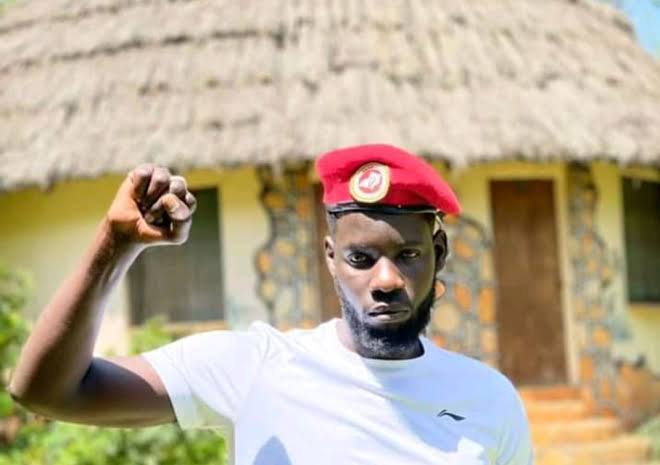
Last month, a controversial comedian from Da Mighty Family, Sammy Okanya, was arrested during the March to Parliament protests.
He was charged with "common nuisance" and remanded to Luzira Prison after appearing before the Buganda Road Magistrate’s Court without his legal representation.
He is one of the few Gen-Z protesters who remains in detention, raising questions among the public about why the state is so focused on his case.
When he returned to court for a bail application, he was granted bail on the conditions that he provides both his national ID and passport, and pays a cash bail of Shs 500,000.
However, Okanya could only meet the conditions of providing his national ID and paying the cash bail, as he lost his passport during the scuffle leading to his arrest.
Okanya’s lawyer, Ishaq Olega, informed this reporter that his client does not have the passport, as it was lost during the incident.
Despite this, the state insists that Okanya cannot be released without the passport, a stance supported by Magistrate Ronald Kayizi.
Olega is now seeking to overturn the stringent bail conditions imposed on his client, who has been in detention for nearly a month.
He argues that the court’s requirements are unjust and infringe upon Okanya’s right to bail.
"The conditions for bail are excessively harsh. The requirement for a passport, when a national ID is already tendered in court, seems redundant and unreasonable," Olega stated. "According to the law, both documents serve similar identification purposes."
He emphasized that the comedian's national ID should suffice for identification and that the additional requirement of a passport, which Okanya claims to have lost, is unjustifiable.
"We will file an application to review and possibly remove this condition. The law recognizes the national ID as valid for the same purpose as the passport," Olega explained.
The lawyer also addressed accusations of mistreatment during Okanya's detention.
"Our client has reported being beaten. It is for the authorities to prove that no such mistreatment occurred," Olega said.
He added that the conditions of detention have been harsh, which adds urgency to the bail application.
Okanya's detention has been marked by prolonged periods without formal court hearings.
"He was held for an entire week before being brought to court, exceeding the legal timeframe for such procedures," Olega noted.
He emphasized the need for immediate judicial intervention to address the ongoing delays and harsh conditions.
Olega criticised the differential treatment of Okanya compared to other detainees involved in similar charges.
"Other individuals who faced similar public offense charges were released, yet Okanya has been treated differently, likely due to his high public profile," he said.
Olega further argued that the state’s interest in the case is politically motivated.
"The case is politically motivated because of the accused's significant public following and his critical stance on government actions," the lawyer stated.
"The accused’s influential platform sheds light on government excesses, leading to heightened attention from both the public and the government. This increased scrutiny affects how the case is handled."
As Olega prepares to submit the application for bail review, he remains uncertain about the timeline.
"We are dependent on the judicial officer to schedule a hearing. Our application will be submitted soon, and we hope for a prompt response," he said.
In recent months, Generation Z across Africa has increasingly mobilized to challenge their governments. Youth in Kenya, Nigeria, South Africa, and Uganda have led protests against perceived government incompetence and corruption.
In Uganda, inspired by their counterparts in neighboring countries, young people organized a peaceful march to Parliament to make their voices heard. Their demands focused on combating corruption, addressing youth unemployment, enacting electoral reforms, and safeguarding human rights.
One of the key platforms for these youth protests has been Agora Discourse, a digital forum dedicated to human rights, public accountability, and social justice. This platform has facilitated communication through conference calls, including one on X Space, which attracted 409 listeners on the eve of July 23.
Protesters were organized in various locations, including Nasser Road, Kiseka Market, and outside Parliament in Kampala. Unified in their message, they chanted “Anita must resign” and carried placards with the names of corrupt officials, calling for their resignation and an end to corruption.
The recent Generation Z protests in Uganda faced significant challenges, including police crackdowns and road closures. These protests, which aimed to address various socio-political issues, have been criticized for their limited turnout and perceived lack of success.
Under President Museveni, the government responded to the protests with stringent measures.
The police arrested activists and protesters, using force to disperse gatherings. Officers targeted individuals holding placards or exhibiting signs of protest, which hindered the momentum and organization of the demonstrations.
